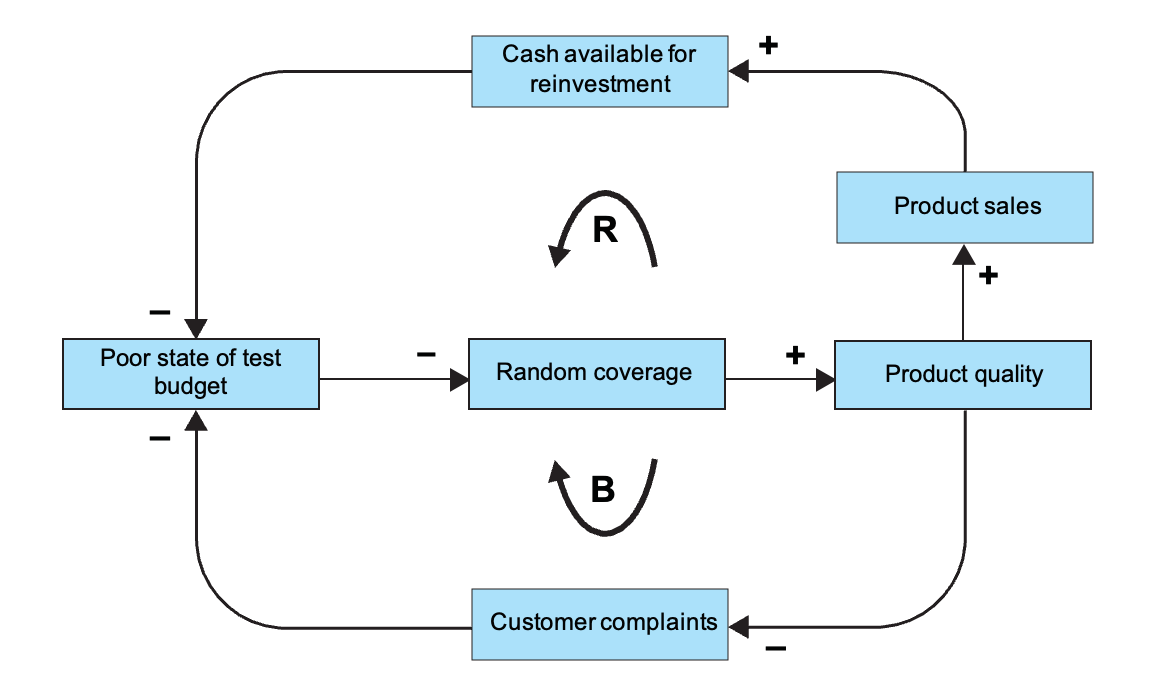
Read the suggestions for how to improve the causal loop diagram and evaluate each of the suggestions individually.
Which TWO suggestions would improve the causal loop diagram (CLD) the most?
Select TWO options.
A.
Customer complaints should be enhanced with the number of last month’s complaints.
B.
Change “random coverage” to “risk-based coverage.”
C.
Rename the variable “poor state of test budget” to “test budget” and change causal links from – to + accordingly to make the diagram easier to understand.
D.
The negative link between “product quality” and “customer complaints” is not a genuine causal relationship and should be further explained with additional variables.
E.
The R loop should be a balancing loop because it contains two minus paths.
A company has several agile teams working on its popular online store. The product manager and product owners (together called product management) are constantly bringing new items to the product backlog to add new functionality, ignoring tasks the software development teams had marked as important enablers. This includes tasks needed to improve reliability.
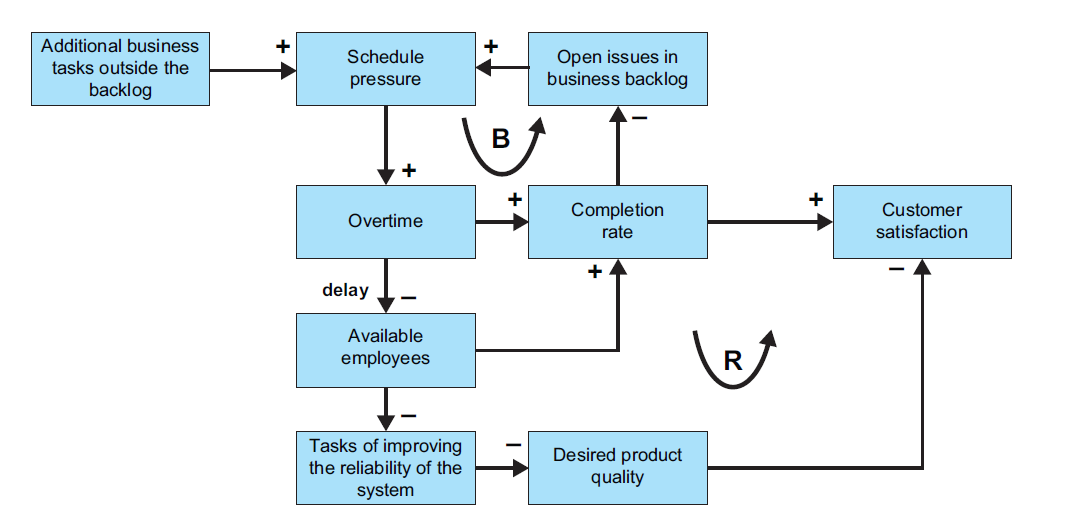
During the last multi-team retrospective, the following causal loop diagram (CLD) was created to understand the consequences of product management continuing to prioritize the business tasks.
Which TWO conclusions would you choose after studying the diagram?
Select TWO options.
A.
Some tasks to improve the reliability of the system must be prioritized and completed to increase customer satisfaction.
B.
The business tasks and the reliability tasks should be analyzed in separate causal loop diagrams.
C.
If the development team works additional overtime, they can also do reliability tasks in parallel with the business tasks outside of the backlog.
D.
The continuous addition of prioritized business tasks results in more team overtime. In the long run, this will decrease the number of employees available to do business tasks.
E.
The reinforcing loop shows how an increase in reliability tasks results in increased customer satisfaction and more available employees.