You work as a test analyst in a project that follows an incremental development model. Each increment consists of four sequential phases: requirements, design, implementation, and testing. Each phase ends with an appropriate test activity, and each increment ends with a release to the customer. After the last increment, the client did not raise any defects during the operation. You collect data on the number of defects introduced and detected in different phases of the last increment. The results are presented in the table below.
For example, the requirements phase introduced 80 defects, and implementation detected 40 of them; static analysis and component testing detected 140 defects in total.
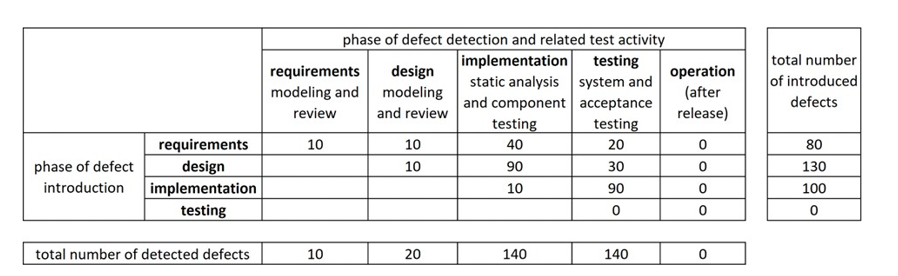
Your management wants to improve defect detection, but due to limited resources, they asked you to select only one phase for which you should carry out the improvement actions. You base your choice on calculating defect detection percentage as the test effectiveness measure for each phase.
Which phase and test activity should you select for the improvement actions?
Select ONE option.
Select ONE option.
A home security system architecture comprises four components: a control panel, a user interface, a cloud-based backend system, and an event processing engine.
In similar projects within your organization, a strong correlation was observed between the size of the components and the number of defects found in component testing. On average, one defect was found per 50 lines of code. You use this model to predict the number of defects in each component.
The test results for the individual system components, containing the actual number of defects, are as follows:

You use defect cluster analysis to identify defect-prone areas. Which component, when tested more rigorously, will probably reveal more defects?
Select ONE option.