TM-2.3.1 K3 Apply
Implement a defect management process, including the defect workflow, that can be used to monitor and control defects
Each phase of the SDLC should include activities to detect and remove potential defects. For example, static testing techniques (i.e. reviews and static analysis) can be used on design specifications, requirements specifications and code prior to delivering those work products into subsequent activities. The earlier each defect is detected and removed, the lower the overall cost of quality for the product. Cost of quality is minimized when each defect is removed within the same phase in which it was introduced (i.e., when the software process achieves perfect phase containment).
During static testing we search for defects. During dynamic testing the presence of a defect is revealed when it causes a failure, which results in a discrepancy between the actual results and the expected results of a test (i.e., an anomaly). In some cases, a false-negative result occurs when the tester does not observe the anomaly. When an anomaly is observed, further investigation should be performed. This investigation usually starts with completing a defect report in accordance with the defined test and defect management process. A failed test does not always result in the creation of a defect report. (For example, in test-driven development, where component tests, usually automated, are used as a form of executable design specification). Until the development of the component is complete, some or all of the tests must initially fail. Until the development of the component is complete, some or all of the tests must initially fail. Therefore, the result of such a test is not necessarily caused by a defect and is typically not tracked via a defect report.
A defect report progresses along a workflow (for simplicity and consistency with most defect management tools we will further use the term “defect workflow”) and moves through a sequence of defect states. In most of these states, one person owns the defect report and is responsible for carrying out a task (e.g., analysis, defect removal, or confirmation test). The following diagram represents a simple defect workflow:
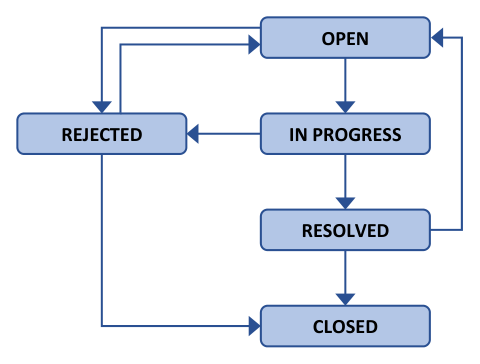
Figure 2: A Simple Defect Workflow
A simple defect workflow may cover the following defect states:
A simple defect workflow is used in many organizations and is extended by the use of other defect states relevant for a given context (e.g., RE-OPENED, ACCEPTED, CLARIFICATION, or DEFERRED).
The defect workflow may vary in different organizations in terms of different names of the defect states, rules for transitions among defect states and roles responsible for tasks in given defect states. Often the defect workflow is more simple in Agile software development than in sequential development models. The defect workflow should be adapted to a given context. When designing the defect workflow, it is advisable to respect several good practices:
Successful test team leadership demands continuous evaluation of situational factors and strategic adjustment of management approaches to optimize test team effectiveness and communication outcomes. Using models such as Tuckman’s stages of group development (Tuckman, 1965) may help the TME to adapt their management approach regarding test team management.
Information and guidance assessment. The TME evaluates team information needs through systematic analysis of project complexity, stakeholders' expectations, regulatory requirements, and technical dependencies. They include stakeholders' management practices to provide alignment, secure test resources, and reinforce the test organization's value. Metrics should be presented to provide actionable insights without creating perverse incentives. The TME should consider individual test team members' experience levels, domain knowledge, and skill development requirements when determining information depth and delivery frequency and should finally assess external communication demands including executive test reporting, cross-functional collaboration, and client interaction requirements.
The TME analyzes current information flow effectiveness by identifying gaps, redundancies, and communication barriers. The TME evaluates existing documentation quality, accessibility, and relevance to current project objectives, and consider temporal factors affecting information currency and decisionmaking timeframes.
Situational leadership adaptation. The TME adjusts management style based on test team maturity, project phase, organization culture, and stakeholders' pressures. More directive approaches may be applied during crisis situations. Inexperienced test team members require structured guidance. The TME implements coaching styles for developing team members needing skill enhancement and confidence building.
The TME uses supportive leadership for competent test team members facing motivational challenges or external pressures. They deploy delegating approaches with experienced, self-motivated professionals capable of autonomous decision-making. They consider cultural factors, generational differences, and individual personality types when selecting appropriate leadership styles.
Communication method optimization. The TME selects communication channels based on message urgency, complexity, audience preferences, and geographic distribution, and uses face-to-face interactions (if possible) for sensitive discussions, complex problem-solving, and relationship building. They implement digital collaboration tools for routine updates, document sharing, and asynchronous communication across time zones.
The TME designs communication frequency and format considering project volatility, stakeholders’ concern levels, and test team confidence requirements. They create communication protocols addressing escalation procedures, decision-making authority, and information security requirements, and establish feedback mechanisms supporting bidirectional communication effectiveness and continuous improvement.
Strategic communication planning. The TME develops comprehensive communication strategies aligning with organizational objectives, project timelines, and stakeholders' expectations. They create communication calendars coordinating test team meetings, stakeholders' updates, and critical decision points. They also design crisis communication procedures addressing rapid response requirements and stakeholders' management during challenging situations.
Leadership incorporates emotional intelligence, cultural competency, and digital communication mastery reflecting workplace dynamics and distributed test team management requirements. They also include proactive stakeholders' management to secure necessary test resources, maintain alignment with organizational objectives, and reinforce the strategic value of testing within the wider business context. Stakeholders' management strategies include regular engagement, transparent test reporting, and negotiation skills to reconcile conflicting priorities.
The learning objectives explained by the sections found for this search, in the same order.
Implement a defect management process, including the defect workflow, that can be used to monitor and control defects
Evaluate the information and guidance needed by the test team, adjust management and leadership approach based on circumstances to determine the most effective method of communication
None of the sections found for this search explains a learning objective.
No learning objectives match the current filters.
Business outcomes whose code or wording matches your search, with the learning objectives linked to each.
No business outcome matches this search.
No business outcomes match the current filters.
Keywords that the syllabi list at the start of a chapter — ISTQB Glossary keywords and domain-specific keywords — matching your search. Definitions are the ISTQB Glossary's.
No chapter keyword matches this search.
No keywords match the current filters.
Questions from the published sample exams that match your search — in the question, its answer options, or the objective or keyword it tests.
As a tester you are typically required to create a defect report whenever you observe a defect during testing. However, there may be situations where you might not create a defect report. Which of the following is a reason why a defect report may NOT be…
The diagram shows an incomplete defect workflow, where two states (states X and Y) have yet to be named appropriately. Which of the following would correctly complete the workflow?
No sample exam question matches this search.
No exam questions match the current filters.